
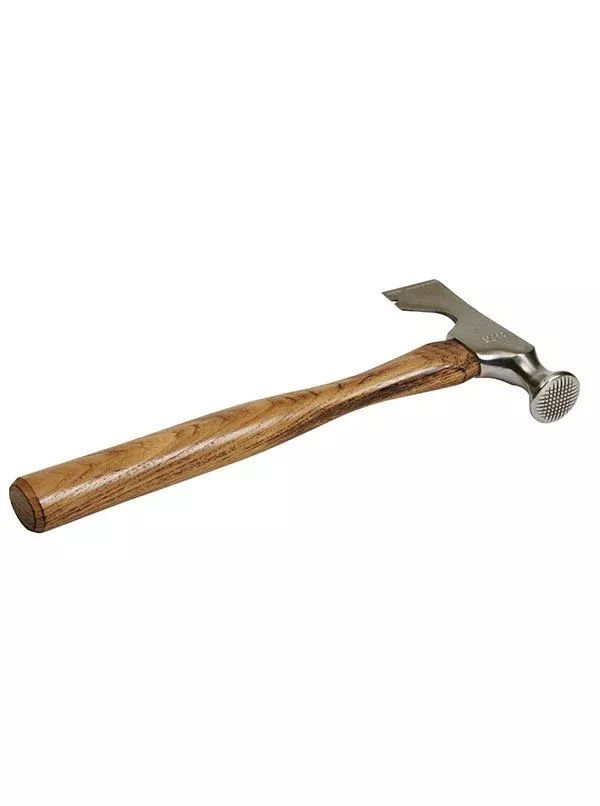
Is this the right tool for your job?
✕CHOOSE A DIFFERENT TOOL WHEN
- It is not the primary fastener on a modern wall — screws are, driven to depth by the 09039 or a screw gun; the hammer’s fastening job survives mainly on nailed and repair work.
- It is not a finish or framing hammer — the crowned face is wrong for a finish nail and the hatchet is not a framing axe.
- It is not a pry bar for the middle of a sheet — levered off unsupported board it breaks the board instead of moving it.
- It cannot claim its own specifications — until the register clears, it is the pattern described here, and any buyer wanting a stated head weight or face type should wait for the confirmed build sheet rather than infer one from this page.
Jobs this tool does
EXACT JOB METHODS FOR HYDE №09068✓ Job guideHow to Set and Dimple Drywall NailsOPEN JOB GUIDE →
For these jobs—use this instead
THE JOB, THE REASON, AND THE BETTER TOOL✕ Driving modern wall fastenersScrews are, driven to depth by the 09039 or a screw gun; the hammer’s fastening job survives mainly on nailed and repair work. BETTER TOOL Drywall Adapter Bit 09039 →
How the pros run it
01
Dimple, don’t drive through
The last blow is a controlled tap, not a swing — the crowned face wants to seat the paper, and one blow too hard tears the dimple and kills the fastener. Always block a persuasion tap. A face on a bare edge crushes it; a face on a sacrificial block moves the sheet. Pry from a bearing point. Lever the hatchet end off framing or a solid edge, not off the middle of a hung sheet, which just breaks the board. Respect the utility scope. The blade is for rough board cuts and trims, not finish carpentry and not a wood axe. (All technique here is pattern technique — head weight and balance, which drive the feel of every stroke above, are unverified for this SKU; the PDP does not state them.)
02
A safety note that is real rather than boilerplate
struck-tool work throws chips, and dry-scoring or chopping old painted board in a pre-1978 building can release lead-bearing dust — eye protection always, and the pre-1978 lead-paint boundary applies to the blade end wherever it disturbs old coatings.