
Is this the right tool for your job?
✓CHOOSE THIS WHEN
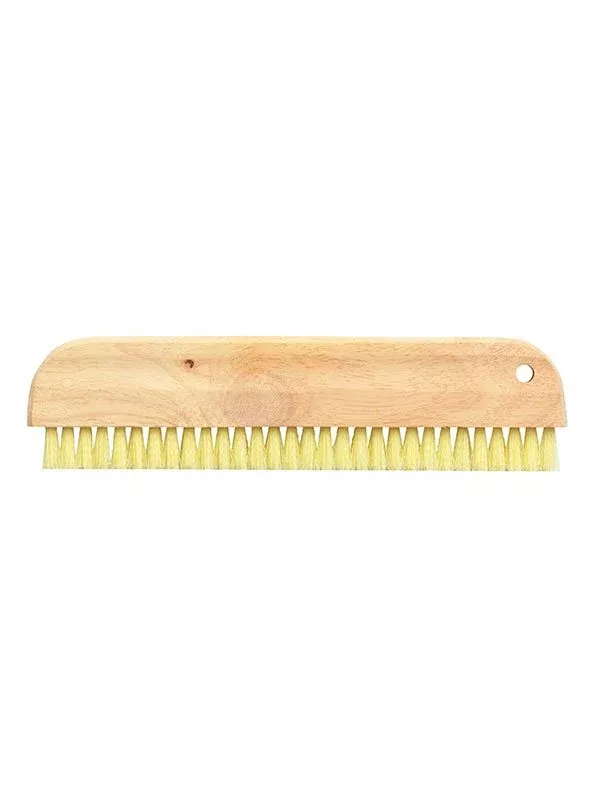
- Smooth wallcovering during application. One-piece hardwood handle with single row of polypropylene bristles. Measures 12″ overall.
✕CHOOSE A DIFFERENT TOOL WHEN
- It is not a texture brush — the exact opposite.
- Where the 09880/09885 texture brushes deposit a raised stomp pattern, this brush removes raised features (air, paste ridges) to lay the surface dead flat; using one for the other’s job makes no sense at either end.
- It is not a trim tool — it has no edge to crease a corner or guide a blade; creasing and cutting belong to a hard smoothing/trim tool or a broad knife.
- It is not the fast choice on tough vinyl, washable, or non-woven stock — there a hard poly smoother seats faster and flatter, and the relief you’d protect with bristles isn’t there to protect.
- And it carries no coating — it is not a paint or paste applicator; it applies pressure, nothing else.
For these jobs—use this instead
THE JOB, THE REASON, AND THE BETTER TOOL✕ Depositing raised textureWhere the 09880/09885 texture brushes deposit a raised stomp pattern, this brush removes raised features (air, paste ridges) to lay the surface dead flat; using one for the other’s job makes no sense… BETTER TOOL Single Texture Brush 09880 →
How the pros run it
01
Center-out, always
spine first, then diagonal strokes to the edges, each one giving air and paste an escape route. Firm enough to move paste, light enough not to stretch the strip or squeeze the bed dry — you are relocating material, not compressing paper. Chase to the nearest edge, never inward. Keep the face clean — wipe paste squeeze-out off the paper the instant it shows at an edge, with a clean damp sponge, blotting not scrubbing. Test on a scrap when unsure whether a stock wants this brush or the hard smoother — a pasted offcut answers the question before the wall pays for it. Finish under raking light — a flashlight held flat to the wall turns every surviving bubble into a shadow while there’s still time to fix it.