Is this the right tool for your job?
✕CHOOSE A DIFFERENT TOOL WHEN
- Wall repair — despite being the one spatula wider than a putty knife.
- No spackling, no patching, no nail holes: the handle is not behind the blade and the blade is not shaped to press and feather across a surface (see 5, first bullet — this is the page’s load-bearing boundary).
- Not whole-gallon or pail remixing — paddle and drill-mixer territory.
- Not rim channels, not pin holes — the exclusions above.
- Not scraping paint off buildings; nothing in this line scrapes anything but container walls and mixing boards.
Jobs this tool does
EXACT JOB METHODS FOR HYDE №41110✓ Job guideHow to Mix Small Batches of Compound or Filler on a BoardOPEN JOB GUIDE →✓ Job guideHow to Scrape a Container Clean and Decant the Last of the MaterialOPEN JOB GUIDE →✓ Job guideHow to Stir a Sample Pot, Jar, or Small CanOPEN JOB GUIDE →✓ Job guideHow to Tint and Match a Small Batch of PaintOPEN JOB GUIDE →
VIEW 1 MORE DOCUMENTED JOB
✓ Job guideHow to Touch Up a Wall InvisiblyOPEN JOB GUIDE →
How the pros run it
01
Grip
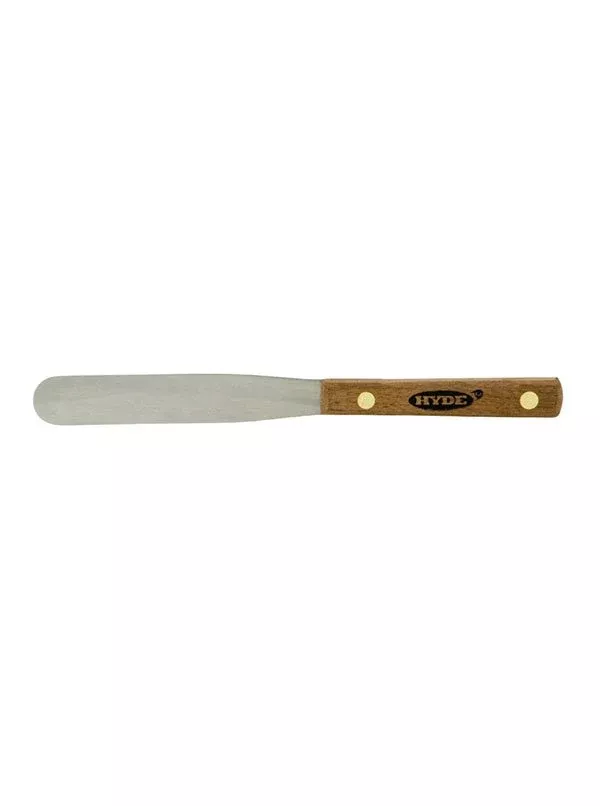
full-handle — this rung does the line’s only leverage work; choke toward the blade for color reads and dab placement, slide back for bottom-scraping and board-kneading. Contact: load the spring to full wall contact and no further; an inch of over-pressed blade lifts at the tip and stripes the wipe. Depth work: in deep containers, angle so the blade leads and the handle trails the rim — the reach is only useful if your hand stays out of the paint. The rag ritual: bare steel between colors, before every cure window, at day’s end. Care: alloy unstated — run the carbon ritual, wipe dry after every wet session; the riveted hardwood scales ask nothing more than the same rag, which is what that build is for.