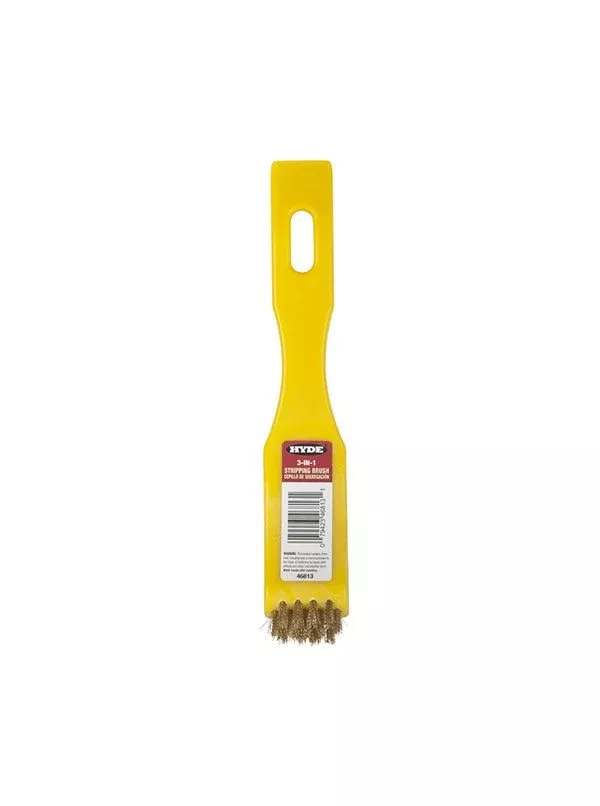
Is this the right tool for your job?
✕CHOOSE A DIFFERENT TOOL WHEN
- Cutting rust, mill scale, or hard cured coatings — nylon and brass don’t cut hard metal deposits; that’s steel-fill territory (a MAXXGRIP, or a carbon/stainless stripping brush).
- Heavy production stripping — it’s an all-in-one homeowner tool, not a fast pro scrubber.
- Prying with the scraper — it’s plastic; it clears softened material, it isn’t a chisel or a pry bar.
- Applying stripper — spread stripper with a sacrificial chip brush; the 46813 removes.
How the pros run it
01
Match the sub-tool to the step. Scraper first on the flats
low angle, shear the softened bulk off, don’t dig (it’s plastic, so it won’t gouge, but forcing it just skips). Nylon next across the open field — moderate pressure, let the stiff nylon scrub the residue loose; nylon is a scrub fill, so it moves softened material rather than cutting hard deposits. Brass detail row last into the profile — light strokes, following the molding, to lift what’s caught in the detail. Throughout, the rule of chemical stripping holds: re-wet, don’t force. If the tools aren’t lifting it, the finish needs more dwell time with the stripper, not more muscle — and if what you’re facing is genuinely hard rust or scale rather than softened finish, this isn’t the tool at all (that’s steel-fill work).