Is this the right tool for your job?
✓CHOOSE THIS WHEN
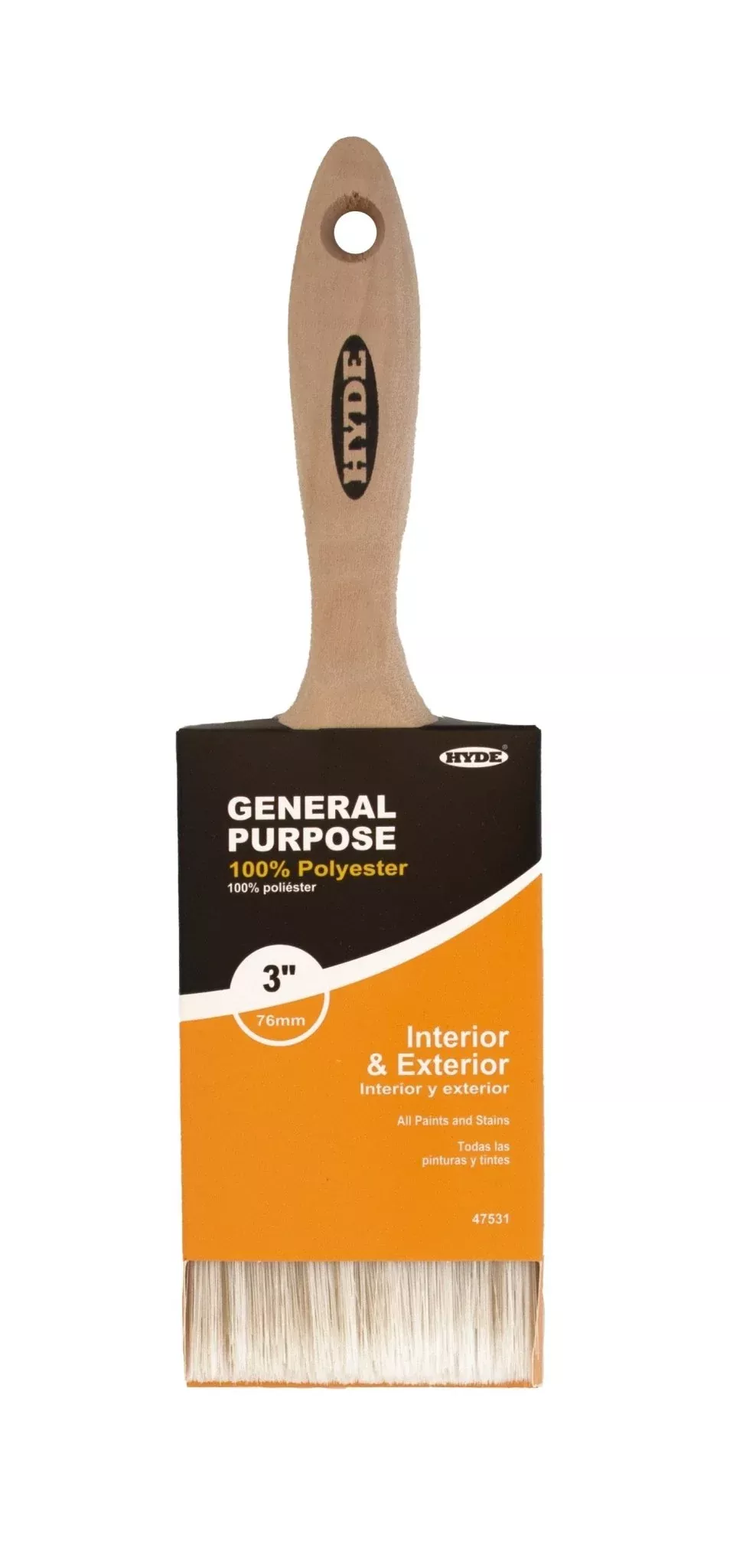
- Bristle Material: Soft, flexible polyester flagged bristles.
- Handle: Beavertail handle for improved grip and control.
- Coating Compatibility: Good for use with both paints and stains.
✕CHOOSE A DIFFERENT TOOL WHEN
- The finest oil-finish lay-off.
- For furniture-grade oil enamel and varnish where a soft white-bristle-style fill levels marks out, Hyde’s Extra™ flats are the specialists; the general-purpose polyester is built for versatility and value, not for the last increment of oil-finish smoothness.
- It is also not an angular sash brush — it is a straight flat, so a crisp cut line wants an angled sash.
- And it is not a premium low-VOC brush: for the fastest-drying, heaviest-bodied acrylics where a straight controlled line is the whole game, Hyde’s SRT lines (E-volution®, Millenium™) are engineered for that paint; the 47531 is the general brush, not the specialist.
Jobs this tool does
EXACT JOB METHODS FOR HYDE №47531✓ Job guideHow to Paint Interior Trim, Doors, and WindowsOPEN JOB GUIDE →
How the pros run it
01
Loading
dip to a third of the bristle and tap off; flagged polyester holds a genuine charge, so an over-dip runs at the ferrule. Working water-based paint: it flashes faster than oil — keep a wet edge, don’t overwork a setting film, and lay off lightly in one direction. Grip: the beavertail’s palm swell suits the long straight strokes of broad water-based work. Cleaning — the ten-year-brush move: water-based paint washes out with warm water and a little soap if you do it before it sets — work the water up into the heel where filament meets ferrule, comb the flagged tips straight, spin or shake dry, and hang. A synthetic brush is nearly immortal if the heel never loads up with dried paint, and ruined the day it does; the failure is always at the heel, not the tip.