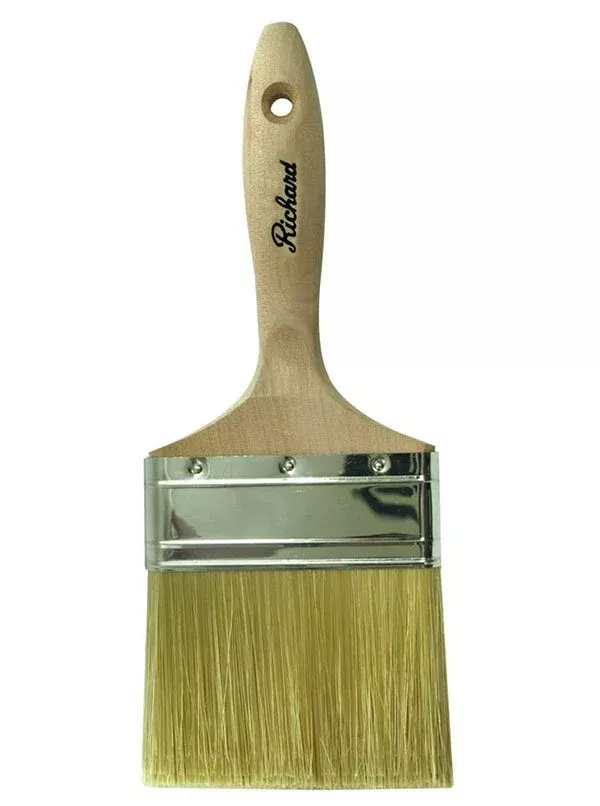
Is this the right tool for your job?
✕CHOOSE A DIFFERENT TOOL WHEN
- Not a paint brush.
- Film coatings — house paint, porch enamel, solid-color deck paint — want a laid, leveled film, and this brush’s entire design is to scrub liquid in, not to lay it on; a General Purpose or Premier paint flat is the tool for those.
- Not a clear-finish brush: varnish and polyurethane magnify every scrub mark, and that work belongs to a fine natural-bristle flat (the white-bristle 80354/80352 for oil finishes), not a thick stain brush.
- Not a detail tool — four inches of face cannot cut a spindle, a muntin, or a tight gap, and the narrower brush owns all of that.
- And not the fastest tool on a big open field, where a stain roller lays faster and the brush’s job shifts to working behind it.
Jobs this tool does
EXACT JOB METHODS FOR RICHARD №80202✓ Job guideHow to Stain Wood Siding and FencesOPEN JOB GUIDE →
For these jobs—use this instead
THE JOB, THE REASON, AND THE BETTER TOOL✕ Clear-finish varnish workVarnish and polyurethane magnify every scrub mark, and that work belongs to a fine natural-bristle flat (the white-bristle 80354/80352 for oil finishes), not a thick stain brush. BETTER TOOL 4″ straight paint brush, GENERAL 80354 →
How the pros run it
01
Load
tips wet, heel dry — a brush loaded to the ferrule carries stain up into the stock and sheds it as drips and as a flooded, blotchy start. Pressure: enough to flex the bristle and feel it drag; a floated stain brush is just a bad pad. Direction: with the grain on every stroke, including the working-in passes — cross-grain scrubbing telegraphs in raked light on anything smooth. The stir ritual: stir at each refill, not just at the start; the pigment drops out in minutes. Mixed bristle, read honestly: natural filament carries oil-based stain beautifully but drinks water and wilts in waterborne products; synthetic filament keeps its spring in water but carries oils less generously; the blend is the both-bases middle, not a specialist in either (class knowledge, not a Richard spec). Cleaning: match the solvent to the base — mineral spirits for oil, warm soapy water for waterborne — worked through until the brush sheds no more color, then combed straight and dried flat or hung. A brush dies at the heel, not the tip: stain left to cure where the filaments meet the ferrule splays it for good, so clean into the heel every time. And the fire rule from §2a governs cleanup day too — spirit-soaked rags go in the metal can or the water, never the pile.