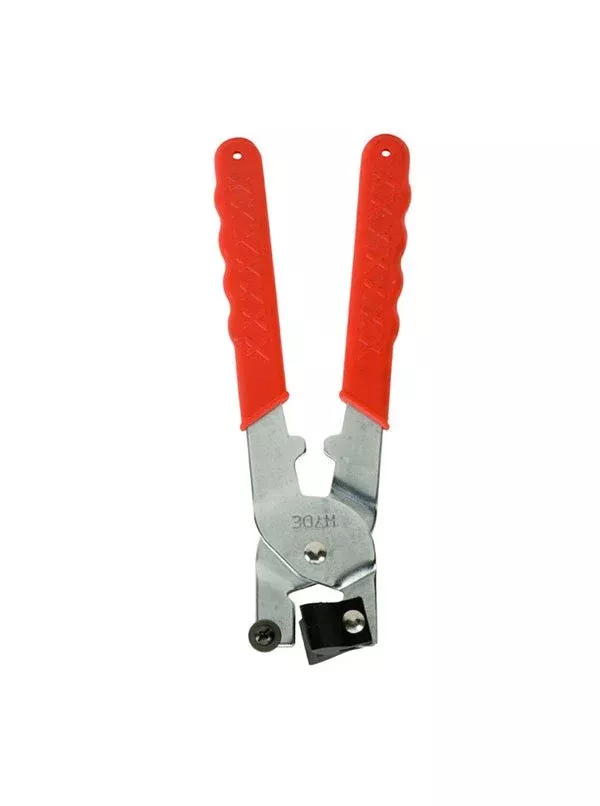
Is this the right tool for your job?
✕CHOOSE A DIFFERENT TOOL WHEN
- Curves — absolutely, not preferentially.
- A curved score will not snap along itself; bending loads the whole line unevenly, the crack leaves your arc at its first opportunity and runs straight, and the tile is scrap.
- The moment the pencil line bends, this tool has nothing, and the nipper or the rod saw takes over.
- Not for interior cutouts — a snap needs the score to run edge to edge.
- Not for slivers thinner than the tile is thick (see the layout law in 2a).
Jobs this tool does
EXACT JOB METHODS FOR HYDE №19410✓ Job guideKnow When You Need a Wet SawOPEN JOB GUIDE →✓ Job guideNotch Tile Around Outlets, Casings, and CornersOPEN JOB GUIDE →✓ Job guideReplace a Single Cracked TileOPEN JOB GUIDE →
How the pros run it
01
Pressure
firm enough to bite through the glaze in one committed stroke — the score should be continuous, audible, and visibly white along its length. A skipping, silent, or intermittent line means more down-force or a fresh grip on the straightedge, and a fresh line. The wheel is the tool: keep it clean and dry, spin it with a thumb now and then to check it turns free, and keep it away from anything abrasive — one pass across cement board would blunt what a thousand tiles won’t (wheel replaceability is claimed, but no replacement wheel is in the store — treat the wheel as the tool’s life until that resolves). The snap: score centered over the bar, both wings pressed at once, no hesitation. When a snap fails, the autopsy is almost always the score: it lifted mid-pass, doubled, or faded at the far edge. Diagnose the line, not the press. Support: on big pieces, back the tile on the bench so the score overhangs a clean straightedge of support — sag opens the crack early and unevenly. Eyes: snapped ceramic occasionally spits a splinter of glaze; glasses on for the snap as well as the nip next door.