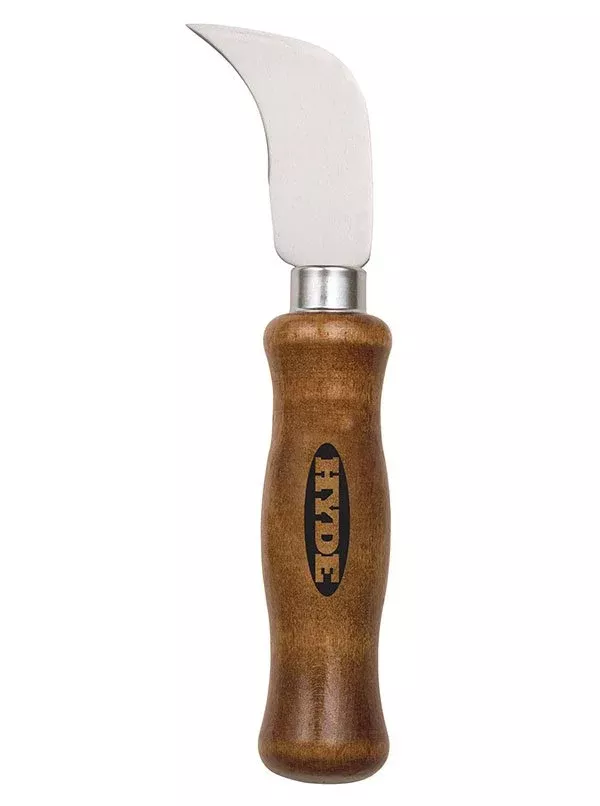
Is this the right tool for your job?
✕CHOOSE A DIFFERENT TOOL WHEN
- Score-and-snap board work as a primary method — the utility knife owns that, and this guide says so rather than inflate the drywall half.
- Not the tear-out knife: strip-cutting bonded flooring side-loads the tip, and Hyde’s durability clause hands that work to the 20250 (or the Black & Silver 20550 when it’s daily).
- Not the vinyl specialist — Hyde prints a vinyl duty line on the 20450, not here.
- Not a roofing knife (20550’s name, not this one’s).
- Not pad-safe over carpet: the open point can reach what’s underneath, and substrate-must-survive pulls belong to the captured hooks (42200, 67090 — other lines).
Jobs this tool does
EXACT JOB METHODS FOR HYDE №20350✓ Job guideHow to Sharpen and Maintain a Flooring KnifeOPEN JOB GUIDE →✓ Job guideHow to Trim and Detail-Cut Drywall with a Trade KnifeOPEN JOB GUIDE →
For these jobs—use this instead
THE JOB, THE REASON, AND THE BETTER TOOL✕ Tear-out on bonded flooringStrip-cutting bonded flooring side-loads the tip, and Hyde’s durability clause hands that work to the 20250 (or the Black & Silver 20550 when it’s daily). BETTER TOOL Flooring Short Point Knife, 2-1/2” 20250 →✕ Vinyl dutyHyde prints a vinyl duty line on the 20450, not here. BETTER TOOL Vinyl Long Point Knife, 2-1/2” 20450 →✕ Roofing workNot a roofing knife (20550’s name, not this one’s). BETTER TOOL Black & Silver® Flooring/Roofing Knife 20550 →✕ Pad-safe carpet pullsThe open point can reach what’s underneath, and substrate-must-survive pulls belong to the captured hooks (42200, 67090 — other lines). BETTER TOOL Heavy Duty Hook Blades (5) 42200 →
How the pros run it
01
The pull cut is the same in both trades
Pierce with the point, lay the blade down, draw toward you, and let the inside curve feed the material into the belly of the edge. The cut changes by material. Resilient sheet is springy, so the curve keeps it seated in the cut. Gypsum core is friable, so the curve helps make a clean slice without crumbling the edge; use a keen edge and a light hand, never force. Depth control differs too: on the floor, the point can ride through to a sacrificial surface; on board, keep the cut shallow and controlled, shaving rather than severing. The long point gives knuckle clearance on long pulls, but the fine tip is not for levering or twisting. For snap-line prying and tear-out, use the short-point 20250; using this spur as a pry will damage it.
02
Keeping the edge — doubly important here
Carbon cutlery steel is made to be maintained, not treated as disposable—especially in drywall work, where gypsum dulls the edge faster than vinyl. Hone the inside curve with a slip stone or dowel-backed abrasive, following the sweep; strop the burr off the outside. Do not rely on a flat bench stone alone, because it flattens the belly of the curve and slowly changes the knife’s shape. Preserve the point—it starts every cut this knife makes in either trade. Wipe dry after wet floor work; neglected carbon steel will rust. If you do not plan to stone the edge, use a utility knife with 42200 hook blades or trapezoid blades instead.