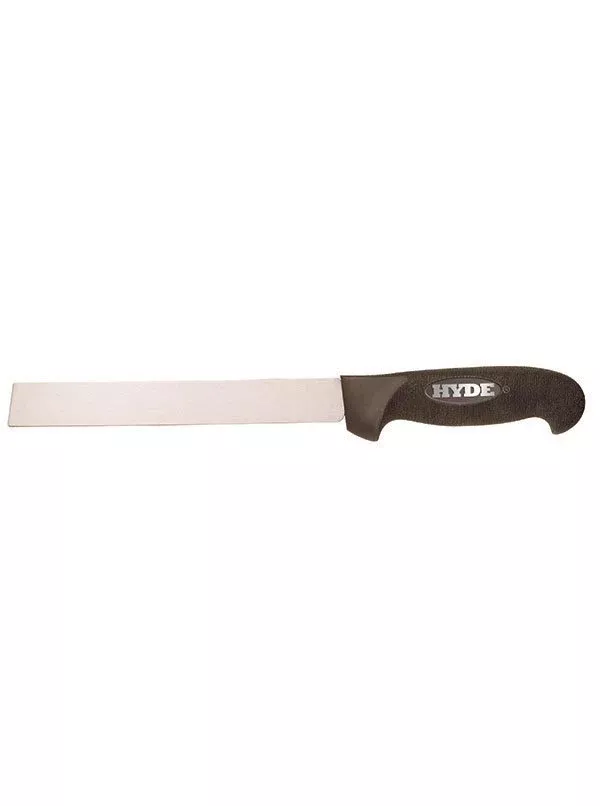
Is this the right tool for your job?
✕CHOOSE A DIFFERENT TOOL WHEN
- Not the close-control tool: shaving flush, steering small gaskets, notching at boxes — the work that happens under the fingertips — belongs to the 4″, and assuming otherwise wastes both knives.
- Not the everyday general knife for a bench that never sees thick stock: that is the 6″‘s seat, and the reason the middle rung exists.
- Not the insulation specialist: daily batts, rigid foam board, and foam-core panels are the 60118’s claim by name , and a plain edge in binding material is working uphill.
- Not a belting or mill knife — the industrial .083″ series (its 8″ member 60780 most directly) carries that duty at a heavier gauge.
- Not a machete, pry, or scraper: length invites leverage, and leverage against the flat of a riveted 1″ blade is abuse, not technique.
Jobs this tool does
EXACT JOB METHODS FOR HYDE №60115✓ Job guideHow to Cut Batt Insulation to LengthOPEN JOB GUIDE →✓ Job guideHow to Cut Fabric and Canvas to a LineOPEN JOB GUIDE →✓ Job guideHow to Cut Flexible Foam and Padding CleanlyOPEN JOB GUIDE →✓ Job guideHow to Cut Underlayment and Wrap to LengthOPEN JOB GUIDE →
VIEW 1 MORE DOCUMENTED JOB
✓ Job guideHow to Run Long Production Trim CutsOPEN JOB GUIDE →
For these jobs—use this instead
THE JOB, THE REASON, AND THE BETTER TOOL✕ Insulation cuttingDaily batts, rigid foam board, and foam-core panels are the 60118’s claim by name , and a plain edge in binding material is working uphill. BETTER TOOL Insulation Knife 60118 →✕ Belting and mill cuttingThe industrial .083″ series (its 8″ member 60780 most directly) carries that duty at a heavier gauge. BETTER TOOL Square Point Knife, Wood Handle 60780 →
How the pros run it
01
Manage the cantilever
Everything distinctive about handling this knife follows from its length. Let the straightedge or the material carry the blade’s far end — the guide, not the wrist, owns the tip. Finish strokes deliberately; the last inch of a long pass is where flutter lives. Reach with the blade so the hand can stay out of deep kerfs — that is what the length is for. Travel, never press: motion parts soft stock; pressure ruptures it. Angle low, start from an edge: the square end plunges into nothing, by design. The four-inch gate: half the blade is the clean-capacity ceiling in soft stock; material beyond it is not on this ladder at all. Edge care, per the accepted claims: the hardened high-carbon steel blade is the maintain-and-return kind — frequent light honing on a fine stone, a dry wipe after damp or adhesive work, attention to the tip half of the edge, which meets the work first in deep stock and dulls ahead of the rest. This straight edge dresses dead-flat on an ordinary bench stone in a few strokes — worth naming, because its wave-edged neighbor cannot make that sentence true. Grind geometry behind the edge is unstated in the record, so none is assumed here .