Is this the right tool for your job?
✕CHOOSE A DIFFERENT TOOL WHEN
- Long production cuts — the short blade means many strokes where a longer numbered knife (the 3, 5, or 6) makes one.
- Heavy rubber, belting, or two-handed force work — the light .058″ blade and bare hardwood handle are built for controlled leather detail, not for leaning through a conveyor belt; that is the .083″ full-size square points’ job, and where policy governs the force, their finger-guard safety siblings’.
- Skiving — thinning an edge is the skiver’s shaving job, not a square-point cut.
- Applying or spreading anything — this is a cutting knife with no flex; it is not a putty or filling knife despite the shared silhouette elsewhere in Hyde’s catalog.
- And it is not a pry bar or a can-opener: the fine leather-bench edge is easy to chip and slow to re-grind if you abuse the point.
Jobs this tool does
EXACT JOB METHODS FOR HYDE №50050✓ Job guideHow to Choose a Pointed Knife vs a Square-End KnifeOPEN JOB GUIDE →
How the pros run it
01
Bench and surface
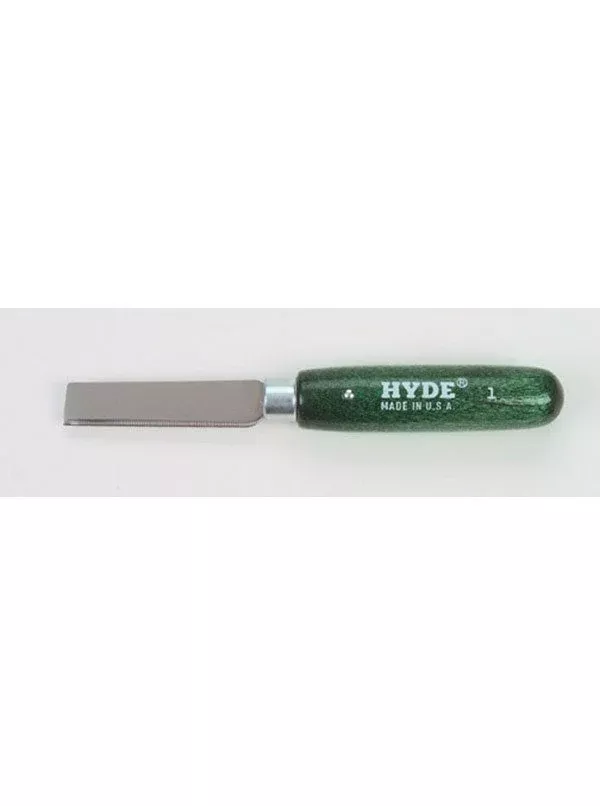
Cut on a sacrificial surface — a poly board or a lift of scrap under the line — never on a bench top that matters; even a square-nosed knife cuts through to what is beneath. Grip for control. Choke up: thumb and forefinger close behind the ferrule, with the blade working like an extension of your fingertips. On the 1, that is the point — it is a short knife made for control, not leverage. Angle the blade. Lay the edge low to slice on the draw; a steep blade chatters and hops on leather. The square end is useful: ride it against the board to work into corners and stop a cut clean. Edge care matters. This is hardened high-carbon cutlery steel, made to be maintained: hone it back to keen on a stone, strop it true, and it will trim for years. The trade-off is rust — carbon steel plus moisture can bloom overnight, so wipe the blade dry after any damp, oily, or cased-leather work and it stays clean. That maintain-don’t-replace choice separates this heritage knife from snap-off and utility knives elsewhere in the line, whose blades are consumables.